








The JWT tab is a workbench for JSON Web Tokens: decode one, edit its claims and re-sign it, and generate the classic attack payloads to test against the server. It goes further than the Decoder's read-only jwt-decode converter, which only shows you the parts.
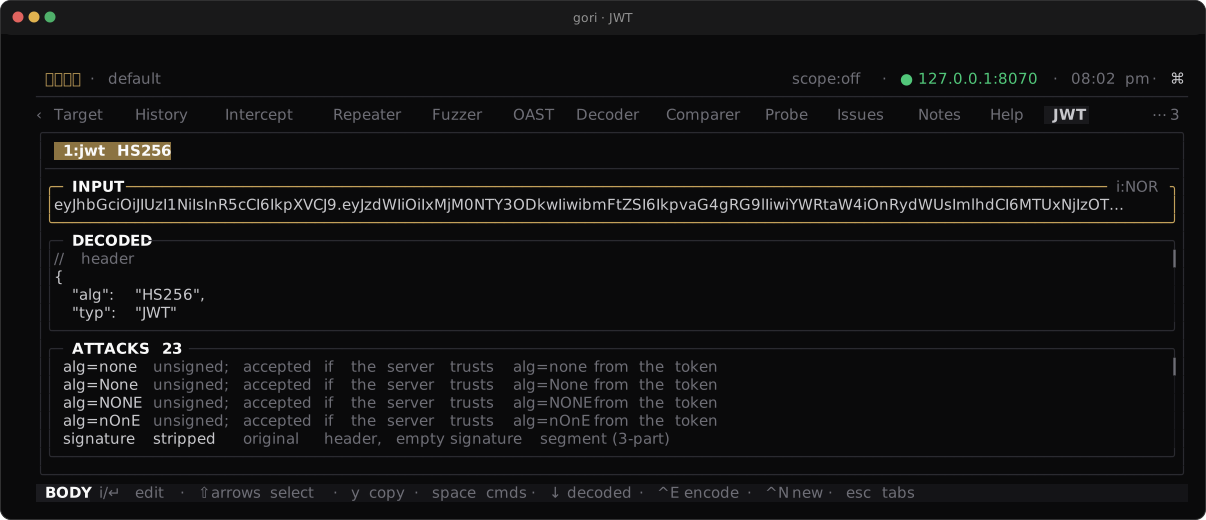
Select a token anywhere (a History detail pane, Notes, …) and Space S (Send selection to…) → j JWT to seed a new workbench sub-tab with it. Sessions are ephemeral: nothing is written to disk. The tab is off the bar by default: press 0 and type "jwt", use the command palette (Ctrl-P → Go to JWT), or give it a slot in Preferences.
Two Lenses
One session, two views, toggled with Ctrl-T. The top card of each lens carries the switch on its border (^T:→ENCODE on INPUT, ^T:→DECODE on HEADER), and clicking it does the same thing as the key:
- Decode: paste a token into INPUT and the header, payload, and signature decode live. Below them is a selectable list of generated attack payloads.
- Encode: edit the HEADER and PAYLOAD as JSON, choose an algorithm (
Ctrl-Acycles the HMAC family, thenRS/PS/ESat 256/384/512,EdDSA, andnone), set a SECRET, and the re-signed token appears live in OUTPUT. For an asymmetric algorithm the card becomes KEY and takes a path to a PEM private key instead of a typed secret.
Space → Load decoded claims loads the token currently decoded on the Decode side into the Encode editors, so you can tweak a claim and re-sign in two moves. Copy any result with y.
A signature is decoded and shown but never verified on the Decode side, so a decode tells you what a token claims, not whether it is trusted. Encode genuinely signs with the key and algorithm you give it, and
gori run jwt --verify(or MCPjwt_verify) answers the trust question when you hold the key.
Algorithms
HMAC (HS256 / HS384 / HS512) signs with a secret you type. The asymmetric families sign with a PEM key you supply. gori generates none, so forging an RS256 token still requires the RS256 private key:
| Family | Algorithms | Key |
|---|---|---|
| HMAC | HS256 HS384 HS512 |
the shared secret, inline |
| RSA PKCS#1 | RS256 RS384 RS512 |
an RSA private key to sign, public key / certificate to verify |
| RSA-PSS | PS256 PS384 PS512 |
the same RSA key; salt length is the digest length (RFC 7518 §3.5) |
| ECDSA | ES256 ES384 ES512 |
a P-256 / P-384 / P-521 key. The signature is the fixed-width r‖s form JOSE mandates, so ES512 is 132 bytes, not 128 |
| EdDSA | EdDSA |
an Ed25519 key |
| Unsigned | none |
none: the auth-bypass shape, offered deliberately |
A key is either inline PEM text or a path to a .pem file. Verification additionally accepts an X.509 certificate (what an IdP publishes as x5c) or the private key itself.
Encrypted Tokens (JWE)
A five-part header.encrypted_key.iv.ciphertext.tag token is a JWE, an encrypted JWT. gori recognizes it everywhere it recognizes a JWS (the JWT tab, the Decoder, the body pretty-printer, gori run jwt, MCP jwt_decode) and shows the protected header: the alg that wrapped the content-encryption key, the enc that encrypted the claims, and the kid.
gori does not decrypt. With no key the claims are marked encrypted and nothing is guessed at in their place, and the projections that only make sense over claims refuse the token outright: --attacks generates nothing (there is no claims segment to tamper with and no signature to strip), and --verify says so rather than reporting an unsupported algorithm.
Attack Payloads
From a decoded token, gori generates ready-to-send variants that probe common JWT verification flaws:
| Attack | What it tests |
|---|---|
| alg:none | Strips the signature and sets alg to none (plus the None / NONE / nOnE case variants), for a server that accepts unsigned tokens. Two more payloads keep the original header: signature stripped (an empty third segment) and no signature segment (a 2-part token). |
| Weak secret | Re-signs the token with a list of common weak HMAC secrets, to catch a guessable signing key. |
| Header injection | Manipulates the kid, jku, x5u, and jwk header parameters, for a server that trusts attacker-supplied key material. |
| Algorithm confusion | Only with the server's public key (--attacks --key, MCP public_key). Downgrades an RS/PS/ES token to HS256 and HMAC-signs it with the public key's own bytes, for a server that dispatches on the token's alg and reuses its verification key. One payload per spelling a server might hold: the canonical SPKI PEM OpenSSL would write, and the bytes as supplied with and without a trailing newline. |
Copy the highlighted payload with y and paste it into a Repeater session (or a request you're already editing) to try it against the target.
Headless
gori run jwt eyJhbGci...                       # decode (default)
gori run jwt eyJhbGci... --encode --alg HS256 --secret s3cret
gori run jwt eyJhbGci... --encode --set role=admin --secret s3cret   # patch one claim, re-sign
gori run jwt eyJhbGci... --encode --payload '{"sub":"1","admin":true}' --secret s3cret   # replace the claims wholesale
gori run jwt eyJhbGci... --encode --alg ES256 --key ./private.pem     # sign with an asymmetric key
gori run jwt eyJhbGci... --verify --key ./public.pem                  # does this token check out?
gori run jwt eyJhbGci... --attacks             # print the attack payloads
gori run jwt eyJhbGci... --attacks --key ./public.pem                 # ...plus algorithm confusion
cat token.txt | gori run jwt --attacks         # token from stdin
The token comes from the argument or stdin; there is no project or capture involved (it is pure local compute). --format is text or json. On --encode, --set KEY=VALUE patches one claim (repeatable; the value is JSON when it parses, so admin=true is a boolean and role=admin a string) and --payload JSON replaces the whole claims object; the two are mutually exclusive. --secret and --key fill the same slot, so pass one. --verify needs --secret or --key (pass --secret '' to check the empty secret), prints verified: yes|no with a reason on a no, and exits 1 unless the token verifies, as gori run cookie --verify does. With --format json the no also carries a code to branch on: only after signature_mismatch or key_mismatch (a key of the wrong type for the token's alg) might another key succeed, while unsigned, alg_unsupported, signature_malformed, jwe and the rest mean no key will. Passing both --secret and --key is refused, --secret '' included. See the CLI Reference.
Over MCP, jwt_decode / jwt_verify / jwt_encode / jwt_attacks are read tools available even under --read-only: they touch no network and write nothing. jwt_encode takes the same set / payload claim edits and the same key; jwt_attacks takes public_key. Note that key / public_key accept a path, so those two arguments read a file the caller names. Pass the PEM inline if the client should not reach the filesystem.
Next Steps
- Decoder: decode a JWT inside a longer transform chain
- Sequencer: grade the randomness of a token that is not a JWT
- Repeater & Fuzzer: fire an attack payload at the target