








If a session cookie, CSRF token, password-reset code, or API key is predictable, an attacker can forge or guess it. The Sequencer collects a sample of tokens and grades how random they really are, the gori counterpart of Burp Sequencer or the Caido Sequencer.
The Sequencer tab is off the bar by default. Press 0 and type "seq", or use the command palette (Ctrl-P → Go to Sequencer); give it one of the nine slots in Preferences → Network & Tabs → Tabs.
Two Ways to Feed It
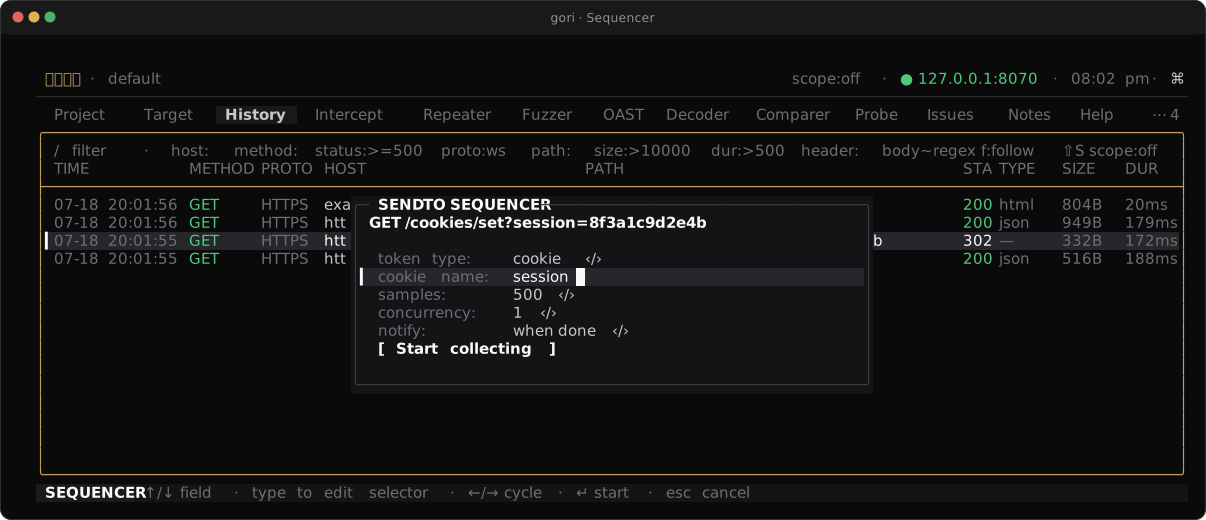
Live. Point it at a request that hands out a fresh token, and gori replays that request many times, pulling the token out of each response. From History, select the flow that sets the token and Space > s (Send flow to… → Send to Sequencer). A SEND TO SEQUENCER card opens over the current tab with the likely session cookie auto-detected; set the token location, sample goal and concurrency there, and Start collects in the background without leaving the tab. On the Sequencer tab, c reconfigures a session, Ctrl-R collects again, and Ctrl-X stops.
Manual. Already have a list of tokens? Select them in a text pane (one per line) and Space S (Send selection to…) → s Sequencer for a pure statistical analysis with no network traffic. Each send from another tab opens a new manual session; a send made on the Sequencer tab itself, while an idle manual session is focused, appends to it and re-analyzes. Headless, the same is gori run sequence --tokens FILE.
Extract the token from any of these locations:
| Location | Extracts |
|---|---|
| Cookie | A Set-Cookie value by name |
| Header | A response header value |
| Regex | Capture group 1 of a body regex |
| Position | A fixed byte range of the body (A:B) |
| JSONPath | A value at a JSON body path ($.data.token) |
Live collection defaults to concurrency 1, because session tokens are often stateful (each request advances a server-side counter). Raise it only when the endpoint is stateless.
Reading the Grade
The headline is effective entropy in bits: a conservative estimate of how much real unpredictability each token carries, measured across the sample. It sets the base rating, and every statistical test below that fails drops it one tier:
| Rating | Effective entropy |
|---|---|
| Secure | >= 88 bits |
| Moderate | >= 60 bits |
| Weak | >= 30 bits |
| Critical | below 30 bits |
Any duplicate or sequential token drops the verdict straight to Critical, however high the entropy looks. Underneath, gori runs a battery of statistical tests over the token's symbol bitstream (monobit, poker, runs, longest-run, per-bit bias, cumulative sums, approximate entropy, and a spectral test), a chi-square on byte frequencies, a lag-1 serial correlation, and a compression check against the alphabet's entropy floor. The tests judged on a p-value share a Bonferroni-corrected threshold, so a clean token is no likelier to be flagged as the battery grows.
A small sample (fewer than ~20 usable tokens) softens hard failures to warnings and caps the rating, since there isn't enough data to be sure.
Structure Is Not Secret
Real tokens usually carry a skeleton: a sess_v1_ prefix, a version byte, base64 padding. The Structure row reports how many positions never vary across the sample, and every byte-level test then measures the varying region only. A position that varies over only a small slice of the alphabet, like a UUIDv4's variant nibble (8/9/a/b), counts as partially fixed: the tests skip it too, and it adds only its own measured entropy to the estimate.
That distinction decides the grade. A token of sess_v1_ plus 24 random hex characters looks like a 19-character alphabet if you count the prefix, which is not a power of two, which switches off the entire bit-test battery as not-applicable; chi-square and compression then fail on a distribution skewed purely by the prefix. Measured against the varying region instead, the same sample is what it actually is: lower-hex, full battery active, every row passing.
For a token whose random part is a suffix behind a variable-length head (123-<random>), gori anchors the per-position window to whichever end carries more entropy, so the head does not drag the estimate down.
The panes are an untitled config card (source and token location, with the ^R RUN / ^X STOP badge on its border), SAMPLES (the collected tokens), and ANALYSIS (the grade and the per-test breakdown), with a TOKEN detail view for any one sample.
Getting the Verdict Out
Collected tokens are live credentials, so they are never written to disk and vanish with the session. The verdict should not.
| Action | Key | Writes |
|---|---|---|
| Export report | ⇧E |
A Markdown report at a path you choose |
| Export report (JSON) | the palette (Ctrl-P) |
The same report as JSON |
| File as issue | Space → a |
An Issue in the Issues tab |
File as issue records the grade in the Issues report, mapping Critical to critical, Weak to high, Moderate to medium, and Secure to info. The Issue carries the target, the token descriptor, the entropy figures, and the full test table as its body, plus the seeding flow as evidence. Neither the export nor the Issue contains a token value: the report is built from frequency tables and verdicts, so there is no sample in it to leak.
Headless
# Live: replay flow 42, extract the SESSIONID cookie, collect 500 tokens
gori run sequence 42 --cookie SESSIONID --count 500

# Manual: analyze tokens you already have (no network)
gori run sequence --tokens tokens.txt
cat tokens.txt | gori run sequence --tokens -
Pick exactly one token location (--cookie / --header / --regex / --position / --jsonpath), and source the request from --flow, --request FILE, or stdin. Rate and transport flags mirror the Fuzzer (--concurrency, --rate, --throttle, --timeout, --target, --http2, …). Output is text, json, jsonl, or markdown (the same document the TUI's Export report writes). Full flags are in the CLI Reference.
Over MCP, sequence_analyze grades a token list inline, and sequence_start / sequence_status / sequence_results / sequence_stop drive a live collection as a background job. Results return the report, never the raw tokens.
Next Steps
- Repeater & Fuzzer: capture the request that mints a token
- JWT: if the token is a JWT, decode and attack it instead
- MCP Server: grade tokens from an agent